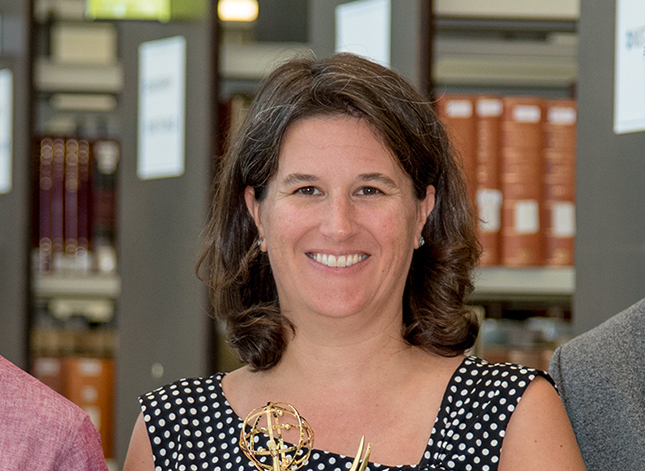
Robin Ferrier Materese (born 1976) was a publicist at Joseph Henry Press, the publishing arm of the National Academies Press in 2003. At the time, she was known as Robin Pinnel and was listed as author of some of the defamatory materials about sex and gender minorities put out in support of their book The Man Who Would Be Queen by J. Michael Bailey. In 2020, she reached out to clarify that she authored only one of the pieces attributed to her. She also asked that this page include her statement below. Per the name she used in her 2020 correspondence, she is referred to as Robin Ferreier below.
Biography
Ferrier is a University of Virginia graduate with a Bachelor’s degree in English, and the former Daily Cavalier student newspaper editor. She also has a Master’s degree in writing from Johns Hopkins. Ferrier used to work for literary agent/lawyer Gail Ross. After leaving Joseph Henry Press in 2005, she worked in communications positions at Choice Hotels International, Johns Hopkins University, the National Heart, Lung, and Blood Institute, and the National Institute of Standards and Technology.
Statement from Robin Ferrier (2020)
On June 24, 2020, Robin Ferrier issued the following statement:
In 2003, I worked as a publicist at the National Academies Press / Joseph Henry Press. I was not part of the editorial decision making or editorial process. My job was to promote the authors / books that we published and help the authors get book reviews, media appearances, event bookings, etc. J. Michael Bailey’s book, ‘The Man Who Would Be Queen,’ was one such book. Ultimately, the Press’ decision to publish that book, and stand by it when legitimate concerns were raised, was the impetus behind my decision to leave that job.
I joined the Academies because I believed in what it did as an organization. I believed in the power of reputable science. I still believe in the power of reputable science. However, thanks to a number of events in the last few years, and to my recent correspondence with Ms. James, my eyes have been opened to the dangers and damages that can come from bad science.
When Ms. James tells me stories like that of Leelah Alcorn, I feel truly sick to my stomach that I played any role in promoting that book and spreading the damaging ideology it espoused.
Press and promotional materials
She has stated she was author of the following piece:
She said in 2020, “I was listed as the media point of contact on the press release and my name was on the reviewer copy cover letter; however, the text used in all those materials was pulled from pre-approved text written by the senior leadership team at the Joseph Henry Press.”
Materials sometimes attributed to her include:
- Gay, Straight or Lying? Science has the answer (March, 21 2003)
- New book on homosexuality, transsexualism and science (April 2, 2003)
- Reviewer copy cover letter (April 28. 2003)
- Press release (April 28, 2003)
- Classified ad in gay publications (2003)
Community responses
Caitlyn Antrim‘s letter (2003)
Lynn Conway’s commentary (2003)
References
Items in [brackets] are attributed to Ferrier but were “by the senior leadership team,” according to her.
[Pinnel R] (April 3, 2003). new book on homosexuality, transsexualism and science. http://lists.indymedia.org/mailman/public/imc-atlanta-audio/2003-April/000188.html Attachments:
- “controversial ideas” by J. Michael Bailey
- “praise” compiled by Ann Merchant
- “timeline” by Robin Pinnel
[Pinnel R] (March 21, 2003). Gay, Straight or Lying? Science has the answer (21 March 2003) http://glbchat.com/Home/news.asp?articleid=4126 http://www.outintoronto.com/home/news.asp?articleid=4126
National Academies Press (retrieved June 2003) http://www.nap.edu/catalog/10530.html
Joseph Henry Press (2003) [open letter] http://www.jhpress.org/press_release/10530openletter.pdf
Joseph Henry Press (April 28, 2003). [press release] http://www.jhpress.org/press_release/10530.pdf
Resources
LinkedIn: robin-materese-9458134
Twitter: rmaterese
Instagram: rlmaterese
Note: an earlier version of this page included inaccuracies that were corrected and clarified with the subject’s input in 2020.