![]() |
|
|
Financing Insurance Workplace Legal issues Name choice Name change Driver’s license Birth certificate Passport Marriage Will Other documents
|
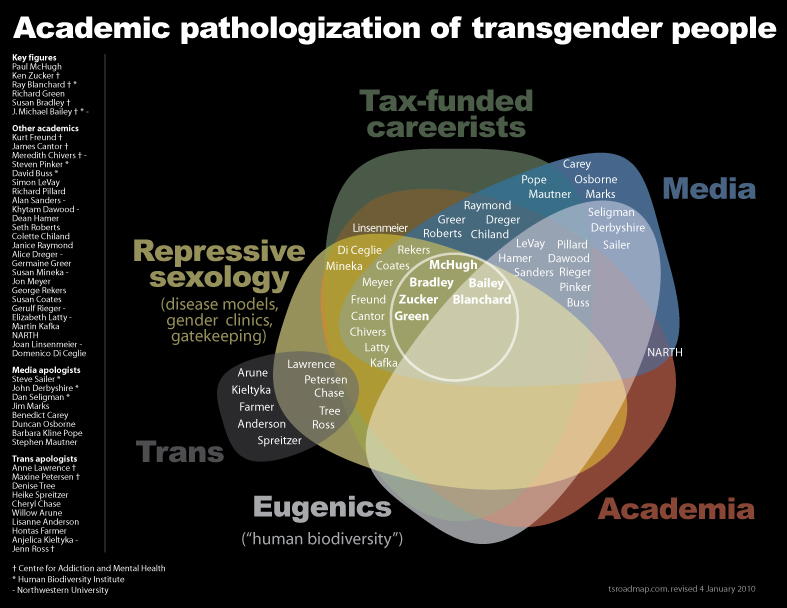
Categorically wrong? A Bailey-Blanchard-Lawrence clearinghouse This clearinghouse explores varying viewpoints about The Man Who Would Be Queen and the ideology that informs the work of J. Michael Bailey, Ray Blanchard, and Anne Lawrence. This clearinghouse was created in April 2003 to document materials in this controversy as they became available. Though much of it remains in an unsynthesized format, pages about key people and concepts have been updated in some cases. Due to renewed interest in the topic following attacks on Bailey's critics by his coworker Alice Dreger, links and descriptions are being updated throughout. For a chronological overview of this matter, please see the timeline of events compiled by Professor Lynn Conway. Section history: revised 26 June 2008 Background In March 2003, J. Michael Bailey, then Chair of the Psychology Department at Northwestern University, published The Man Who Would Be Queen: The Science of Gender-Bending and Transsexualism. Despite having science in the title and being promoted as original research, many consider the book scientifically unsound and deeply biased. It describes gender variance in metaphors of disease and impairment that are an extension of Bailey's belief that homosexuality is an evolutionary mistake and a developmental error. Bailey's writings on homosexual eugenics and his belief that male bisexuals are liars echo his thinking on trans issues as well. Bailey's book is based on an obscure and outdated model of gender variance created by Ray Blanchard of Toronto's notorious Clarke Institute. Bailey's and Blanchard's models contradict cutting-edge research by renowned experts on causes and motivations of those who express gender variance. Initial positive spin created by Joseph Henry Press publicist Robin Pinnel and a handful of Bailey supporters (primarily sexologist Anne Lawrence and members of a conservative-run eugenics thinktank) quickly gave way to a deluge of negative responses by a wide range of concerned communities, starting with academics, notably those responding to Bailey's lectures exploiting gender-variant children. For a sense of the size and global scope of the protest, a petition against the book garnered over 1,300 signatures from 35 countries in just its first few days. Given our percentage of the population, this would be equivalent to obtaining millions of signatures in a few days from the general population. Also speaking out were those of us working to stop defamation of trans people in the media, and even the research subjects portrayed in Baileys book. These voices were later joined by those from the gay, bisexual, transgender, and intersex communities. In early 2004, hate group monitor Southern Poverty Law Center featured Bailey's and Blanchard's ties to neo-eugenicists and right-wing journalists. These early negative reviews were later echoed by many of Baileys own peers in sex research, as well as by clinical experts on transsexualism. In front of large crowds of peers, Kinsey Institute Director John Bancroft M.D. said the book was "not science," and HBIGDA President Dr. Eli Coleman said it was "bad science"). In the wake of this, book sales tanked, Bailey has vacated his position as an officer of the International Academy of Sex Research and was subject of a full investigation by Northwestern University for failure to get informed consent. In November 2003, Bailey's mentor Ray Blanchard finally resigned from HBIGDA after their officers wrote to Northwestern expressing concerns, suggesting that Blanchard will go down in history as what George Rekers is to homosexuality: the old-school holdout who outlived his time. Normally, a book this scientifically unsound and tainted with charges of academic misconduct, practicing without a license, fabricating data, and sex with a research subject would not even be dignified with a response by many involved, but this book somehow got published through the National Academies Press, online via the NAP website and in print through their Joseph Henry Press unit, which specializes in science books for popular audiences. Executive Editor Stephen Mautner claimed in a 24 June 2003 letter that the book was subjected to scientific review and was reviewed as a well-crafted and responsible work. Mautner refers to Bailey as a scientist who follows a legitimate avenue of scholarship and research. In the wake of a full investigation into the systemic failures at the National Academies, they continue to remain silent about their culpability. In November 2004, Northwestern University reported that Bailey resigned as Psychology Department Chair and that Northwestern was taking secret unspecified action against Bailey based on their findings. In February 2006, the online version Bailey's book was quietly removed from the National Academies Press website. Bailey's lurid and unscientific portrayal is easily disproven by successful trans women and men around the world leading joyous and productive lives after transition. Introduction Discrediting Bailey was the easy part. Framing the theoretical issues involved is the profoundly difficult part of this controversy. The Bailey-Blanchard-Lawrence model of gender variance raises several issues regarding reproduction, assimilation, biological determinism, and what it means for trans people and society at large. Please note that many of the concepts and terms discussed in the following articles are controversial and/or inconclusive. They give a sense of the issues at hand, and are not definitive statements on any particular subject.
The investigation This site is designed to complement the concurrent Investigative Report by Lynn Conway. Our research into how this book got published and promoted focuses on the following six entities.
The response
Theoretical issues
Lighter fare
|
|
|
|
||